A Letter from the Hills
An Envelope Smelling of Tea
The letter arrived on a sticky Tuesday in June, when the whole of south Kolkata seemed to be sweating under a grey lid of cloud. Mrs Anjali Basu, sixty-four years old, retired after thirty-five years of teaching history to girls who mostly wanted to talk about film stars, was sitting on her balcony with a cup of tea and the crossword. The postman handed the envelope up through the grille, and she knew the handwriting at once: tall, leaning letters, like a row of pine trees bending in the wind.
“Leela,” she said aloud, and smiled.
Leela Pradhan had been her room-mate in the college hostel, more than forty years ago. They had shared one fan, one mirror, and a great many secrets. Then Leela had married Harka Pradhan and gone up to the hills to live on his family’s tea estate, and for four decades their friendship had travelled by post, by the occasional phone call, and by a parcel of tea that arrived every spring without fail.
Anjali slit the envelope with her butter knife. A faint smell came out of it, green and flowery, like a garden after rain. Leela had tucked a few dry tea leaves inside, as she always did.
Come up, Anju. The house is too big and too quiet since Harka went. The rains have started, but the mist is beautiful, and Pemba still makes the best momos on the ridge. Bring that clever grandson of yours. I have something to show you both before it leaves Kanchanjhora for ever.
— From Leela’s letter
Anjali read the last line twice. Before it leaves Kanchanjhora for ever. Leela was not a woman who wrote mysterious sentences for fun.
Rohan Is Persuaded
Her grandson Rohan was nineteen, in his second year of a physics degree, and at that moment lying on the sofa inside with his phone held above his face. He had come to stay with her for the summer holidays because, as he put it, his parents’ flat had “no Wi-Fi worth the name and too many rules”.
“Ronu,” she called. “How would you like to go to Darjeeling?”
“In the monsoon?” He did not lower the phone. “Thamma, it rains there sideways. Roads fall down. People get stuck for days.”
“People also see clouds come in through the window and sit down at the breakfast table,” said Anjali. “And there are birds there you have only seen on that app of yours.”
The phone came down slowly. Rohan had recently discovered birdwatching, which he pretended was a serious scientific hobby and which his grandmother suspected was mostly an excuse to buy a very expensive pair of binoculars. He had a bird identification app on his phone that could recognise a song from three seconds of recording.
“Which birds?”
“Sunbirds. Laughingthrushes. Verditer flycatchers, which are the exact blue of a peacock’s neck. And we will go up on the toy train.”
“The whole way? From the plains?”
“The whole way.”
Rohan sat up. “Fine,” he said, trying to sound bored. “But only because of the train.”
All Aboard at New Jalpaiguri
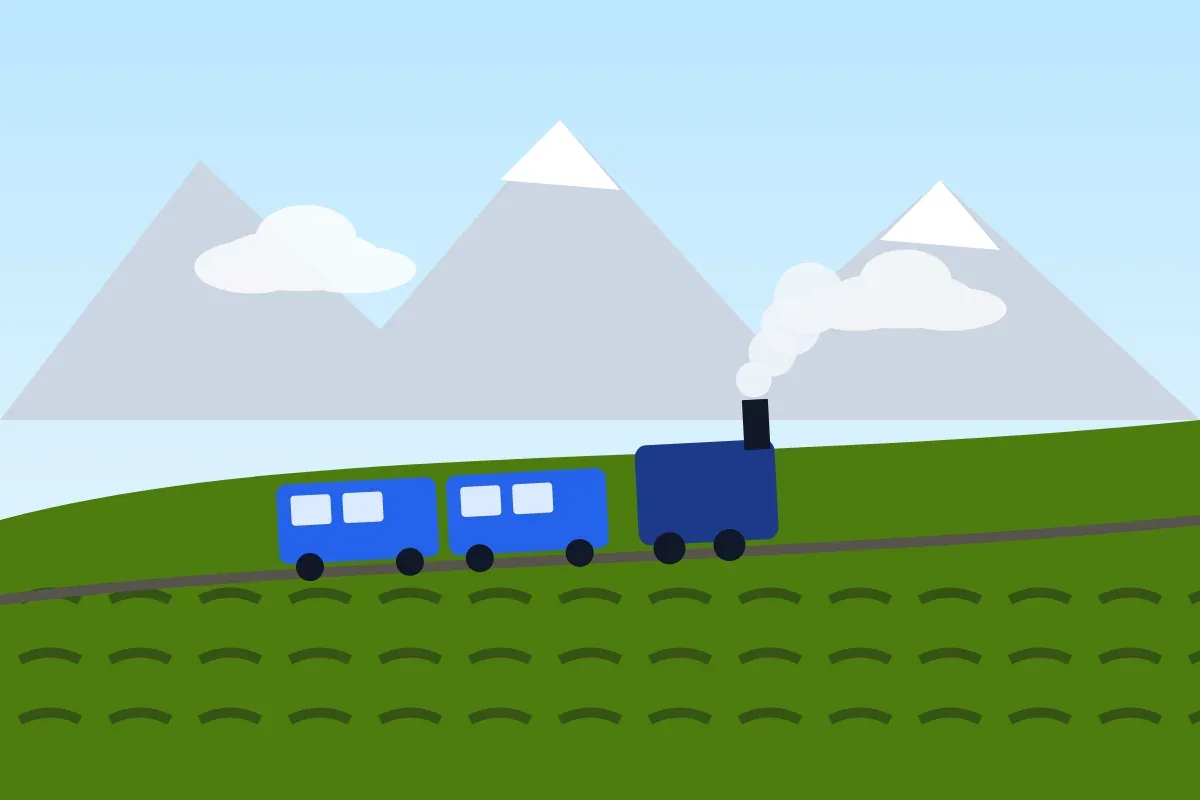
Ten days later they stepped off the overnight train from Sealdah at New Jalpaiguri, stiff and rumpled, into a morning so humid that Anjali’s spectacles fogged at once. The little narrow-gauge train of the Darjeeling Himalayan Railway was waiting on its own platform, looking like a toy that a giant child had left behind: a few small blue carriages, windows wide open, and in front of them a stout engine that hissed and sighed as if it were already tired.
“It is more than a hundred years old,” said Anjali happily, “and it is a World Heritage Site. You are about to ride on history, Ronu.”
“I am about to ride on very hard seats,” said Rohan, but he was already taking photographs.
Their compartment held four other travellers. The first was a young woman in a yellow raincoat with a small camera fixed to a stick, talking brightly into its lens. “Hi, travellers, it’s Ruby on the Road, and today we are going up, up, up into the clouds!” She caught Anjali’s eye and gave an embarrassed little wave. “Sorry, Aunty. Vlog. My followers love trains.”
The second was a large, elegant man of about sixty with a silver moustache and a cream linen jacket that was already wilting in the heat. He held a leather briefcase on his knees as if it contained the crown jewels. He introduced himself as Sebastian D’Costa, a dealer in antiques from Mumbai.
“Tea antiques mostly,” he said. “Silver caddies, old auction catalogues, planters’ diaries. You would be amazed what people will pay for a piece of the past, madam.”
The third was a thin, cheerful man with a neat grey beard, a khaki hat, and a pair of binoculars round his neck. “Dr Arvind Malhotra,” he said, shaking hands with both of them. “Retired physician, from Delhi. Now I chase birds instead of fevers.” He held up a thick bird guide. Rohan noticed that its spine was perfectly stiff, without a single crease, as if it had come out of the bookshop that morning.
As the train jerked forward and began to crawl through the flat green plains towards Sukna, Rohan and the doctor fell into talk about birds. Half an hour later a flash of brilliant blue darted across a tea bush outside the window.
“Ah! A kingfisher,” said Dr Malhotra at once, pointing.
Rohan looked at the bird, then at his app, and frowned. “I think that was a verditer flycatcher, sir. Kingfishers have that big orange chest and a long beak.”
“Did I say kingfisher? I meant flycatcher, of course.” The doctor laughed and polished his binocular lenses with a small yellow cloth. “Old eyes, young man. Old eyes.”
The fourth traveller had said nothing at all. He was an older hill man in a woollen cap, who got off quietly at Tindharia. But as the train began to climb in earnest, looping and zig-zagging up the green mountainside, with the plains falling away below like a map, Sebastian D’Costa leaned towards Anjali.
“You said you are going to Kanchanjhora Estate, madam? So am I. I have an appointment with Mrs Pradhan.” He tapped his briefcase. “About the ledger.”
“What ledger?” asked Anjali.
The dealer’s eyebrows rose. “You don’t know? The Kanchanjhora First-Flush Ledger is one of the most famous objects in the whole history of Darjeeling tea. And very soon,” he added, smiling under his moustache, “it is going to change hands.”
Outside, the first wisps of mist came drifting down the hillside and in through the open window, cool as a wet handkerchief on Anjali’s cheek.