Into the Clouds
The Loops and the Reverses
By noon the plains had disappeared altogether. The little train climbed through forests of tall sal and then of feathery bamboo, and every so often it simply stopped, reversed up a slanting track, and then went forward again on a higher line, like a person climbing a staircase that turned back on itself.
“These are the zig-zags,” Anjali explained to Rohan, who had his head and his phone out of the window. “The slope is too steep to go straight up, so the engineers made the train go back and forth.”
“That is actually very clever,” Rohan admitted. “It’s like the switchbacks on a hiking trail.”
At Kurseong the train ran right through the middle of the bazaar, so close to the shops that Anjali could have bought a packet of biscuits without leaving her seat. Children waved. A dog trotted alongside for a while, then lost interest. Ruby filmed everything, narrating happily to her phone about “the town of white orchids”, while Sebastian D’Costa dozed with both hands still gripping his briefcase.
Dr Malhotra, Rohan noticed, did not use his binoculars much. He spent most of the journey looking quietly out of the window, and as they passed Sonada he said, half to himself, “The cherry trees are gone,” as if he were missing something he had once known well.
“You have been here before, Doctor?” asked Anjali.
He turned, smiling. “Never in my life, madam. But I have read so much about these hills, I feel I know them. Every old book mentions the cherry trees at Sonada.”
Anjali, who had read a great many old books, could not remember a single one that did. But she said nothing, and wrote a small note in the green notebook she always carried in her handbag.
Ghum, the Roof of the Railway
The air grew colder with every mile. Anjali pulled her shawl over her shoulders, and Rohan, who had sworn he would not need a sweater, quietly put on two. By the time they reached Ghum, the mist was so thick that the station sign floated out of it like a ghost.
“Ghum is the highest station on this whole railway,” said Anjali. “More than two thousand metres above the sea. Higher than many hill stations in the world.”
“Ghum means fog, doesn’t it?” said Ruby, turning her camera on them. “That’s what my research says.”
“That is one story,” said Anjali diplomatically. “There are several. But look around you, and you can see why people like that one.”
They were to get off at Ghum, because Kanchanjhora lay on a ridge above the station, not far from the road to Tiger Hill. But first the train had one more trick to show them. It carried on a little way towards Darjeeling, and Leela had arranged for the estate jeep to meet them at the famous Batasia Loop, so that, she wrote, “the children can see it properly”.
The Loop was a great circle of track in which the train spiralled round a garden and came back over itself. In the centre stood a tall stone memorial to the brave Gorkha soldiers who had died serving the country, and around it were beds of flowers, bright even in the grey air. For one magic minute the clouds tore apart, and far away, enormous and white and impossibly high, Anjali saw a shoulder of snow.
“Kanchenjunga,” she whispered.
Rohan stared. He had seen the mountain in a hundred photographs, but nothing had prepared him for the size of it, hanging in the sky above the clouds as if it did not belong to the earth at all. Then the mist closed again, and it was gone.
The Jeep at the Loop
Anjali, Rohan and Sebastian D’Costa got down at the Batasia Loop, and so, to Rohan’s surprise, did Dr Malhotra and Ruby.
“Kanchanjhora is also my homestay,” said Ruby, laughing at their faces. “I booked months ago. It has the best reviews on the whole ridge. ‘Old-world charm and a real khansama’, it says.”
“And I,” said Dr Malhotra, “am told the birding there is excellent.”
A battered green jeep was waiting by the railings. The driver was a broad, cheerful young man called Dorjee, who loaded their bags on the roof and tied them under a blue tarpaulin. Then they bumped and swayed back along the road past Ghum and up a narrow lane that climbed between banks of fern and moss.
And then, all at once, they came out of the forest into the tea.
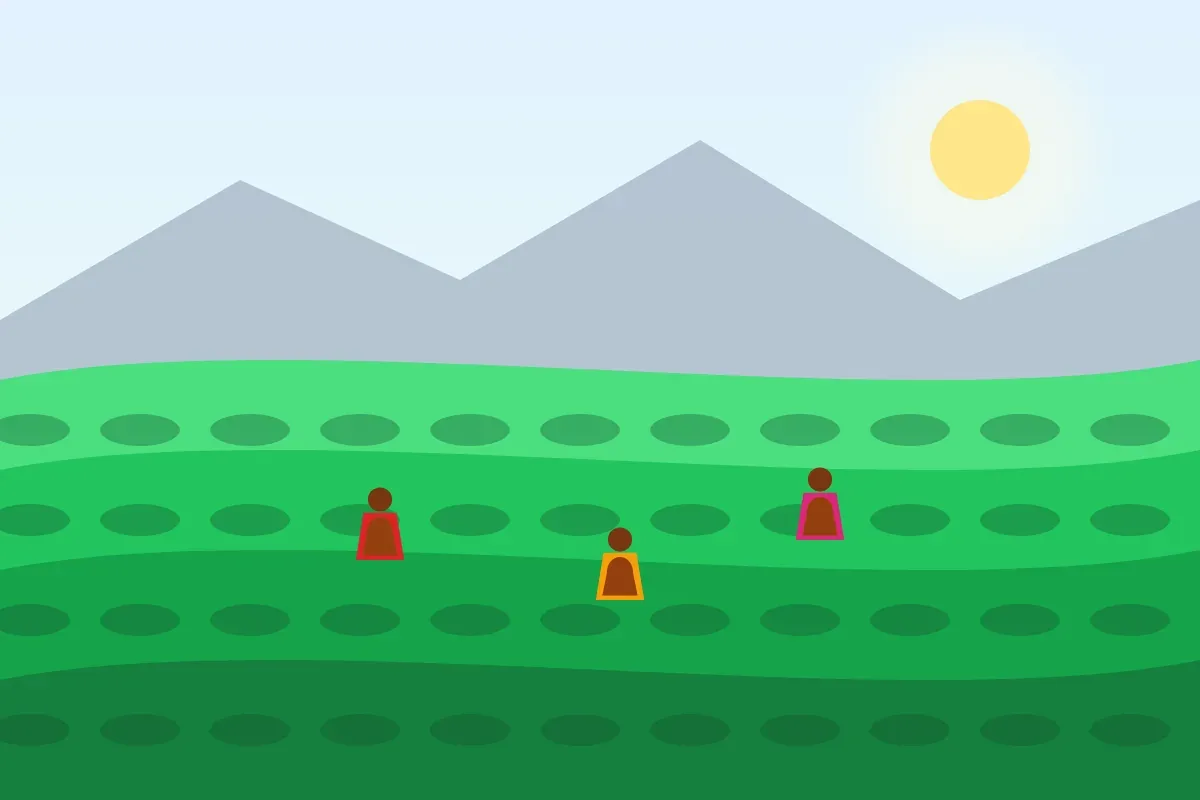
The bushes covered the hills in every direction, clipped flat on top and planted in curving rows that followed the shape of the land, like the lines on a giant thumbprint. Tall shade trees stood among them with their heads in the mist. Here and there, women with long baskets hanging on their backs from a band across the forehead were moving slowly between the rows, their fingers flickering over the bushes.
“They are plucking,” said Anjali. “Two leaves and a bud. That is the rule for good tea.”
“Only two leaves?” said Rohan. “How many bushes does it take to make one packet?”
“More than you would believe,” said Dorjee from the front, grinning. “And the best tea of all is the first flush, in spring, after the winter sleep. Kanchanjhora first flush is famous. My grandmother says it tastes like the mountain is talking to you.”
The jeep rounded a last bend. A wooden gate stood open, and beside it rose an enormous old deodar tree, dark and solemn, its branches spread like the arms of a grandmother. Behind it, at the top of a lawn bright with hydrangeas, stood the bungalow: white walls, a green tin roof, a long glass verandah, and three crooked chimneys already sending up smoke.
“Ah,” said Dr Malhotra softly from the back seat. “The old deodar is still standing.”
Rohan glanced at him. The doctor caught the look and coughed. “I mean, it must be very old. Those photographs on the homestay’s website do not do it justice.”
On the verandah steps a small, straight-backed woman with white hair and a bright red shawl was waving both arms above her head.
“Anju!” she called. “You came!”
And Anjali Basu, who had not run anywhere for at least fifteen years, jumped down from the jeep and ran.